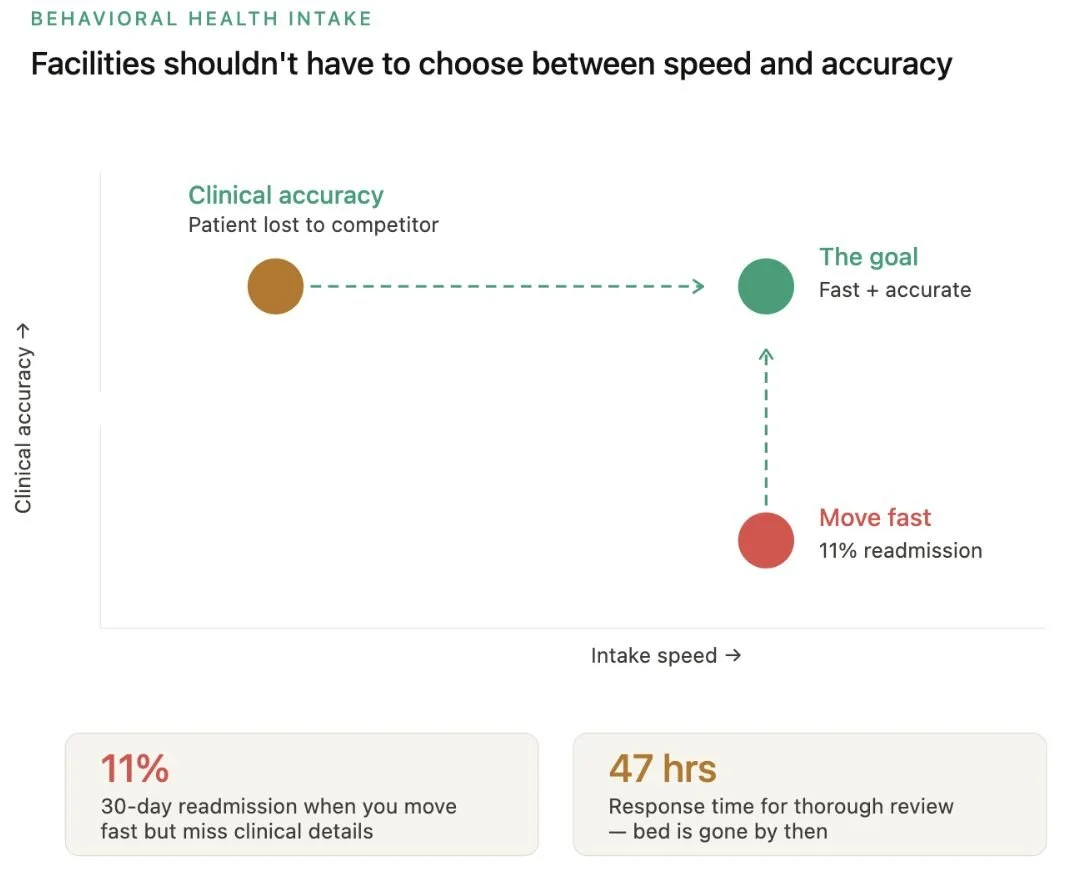

Many behavioral health referrals still arrive as a stack of faxed pages, and someone at the intake desk has to read every one before a unit can say yes. The patient waits while that reading happens.
That wait has consequences at both ends. A patient in crisis can spend it in an emergency department, and a referring hospital that hears nothing back starts calling other facilities. For the operator, that can mean an empty bed and a patient placed somewhere else.
The right behavioral health admissions software shortens the referral wait by reading every page of a faxed, scanned or electronic referral packet, checking it against your admission criteria by unit, level of care and payer, citing the source page for each finding, and assembling medical-necessity evidence for prior authorization. Clinicians and admissions staff still make the placement decision.
Below, we walk through each of those and what to ask a vendor to show you.
Key takeaways
- Beds run past capacity122%/ 104%
SAMHSA's 2023 national facility survey counted more patients than designated beds, in aggregate, at mental health (104%) and combined mental health and substance use facilities (122%) on March 31, 2023.
- Electronic exchange runs thin16%
Figure 5 of ONC Data Brief 71 shows that in 2023, 16% of non-federal acute care hospitals sent summary of care records to most or all behavioral health providers.
- Payer criteria belong in intake87%/ 77%
SAMHSA's 2023 facility survey found that 87% of mental health facilities and 77% of substance use facilities accept Medicaid, so payer criteria belong in each referral review.
- Evidence travels with the requestCitedto the page
A prior authorization request can carry the medical-necessity evidence pulled from the referral packet, with each fact cited to its source page for the payer's reviewer.
Why do multi-facility behavioral health operators need their own admissions software evaluation?
A multi-facility behavioral health operator's units each set their own admission criteria, levels of care and payer rules, so the software has to apply criteria by unit, level of care and payer.
Here, behavioral health (BH) operators are organizations that run inpatient psychiatric facilities, residential substance use disorder (SUD) programs, or BH units inside post-acute groups. An inpatient psychiatric facility (IPF) is a psychiatric hospital or a psychiatric unit of an acute care or critical access hospital.
For those operators, per-site rules multiply quickly. Take a hypothetical operator running two IPFs, three residential SUD programs and one BH unit. Each site applies its own clinical criteria, level of care and payer rules. Three checks at each of six facilities is 18 rule sets to maintain.
Capacity pressure raises the stakes on each of those checks. SAMHSA's 2023 National Substance Use and Mental Health Services Survey divided patients by designated inpatient and residential beds on March 31, 2023, finding ratios of 96% for substance use (SU) facilities, 104% for mental health (MH) facilities and 122% for facilities offering both. At those ratios, a slow decision ties up a scarce bed. For BH sites, post-acute admissions software prepares that decision by reading the referral packet itself.
Source: SAMHSA, 2023 N-SUMHSS annual report. Aggregate patients divided by designated inpatient and residential beds.
How should the software read a behavioral health referral packet?
The software should read every page of a referral packet, whether it arrives as a faxed PDF, a scan, a photo of handwriting or an electronic record, and pull the facts your admission criteria depend on. A referral packet is the set of documents a referring hospital sends with a placement request.
Few hospitals exchange records electronically with most of their BH partners. Figure 5 of ONC's 2023 data brief on hospital interoperability shows that 16% of non-federal acute care hospitals sent summary of care records to most or all BH providers in 2023, and 8% received records from most or all. Intake software therefore has to read faxes and scans as well as electronic records.
Inside each packet, the facts sit across discharge summaries, history and physical (H&P) notes, medication lists and face sheets. Long faxes add a timing test, so ask whether criteria checks start before the last page arrives.
BH packets also carry details that BH units often write into their criteria, such as psychiatric presentation, legal status and substance use history. Legal status is whether the patient is admitting voluntarily or involuntarily, such as under an emergency hold or a court-ordered commitment, under rules that vary by state. Each unit sets its own rules for those details, which is where criteria matching comes in.
How should the software check a referral against criteria by unit, level of care and payer?
The software should hold your admission criteria for each unit, level of care and payer, run acuity and capability screens on each referral, and link each finding to the page it came from. Level of care is the intensity of service a patient needs, from inpatient psychiatric care to residential or outpatient treatment.
Those criteria differ from unit to unit. One IPF unit may set an age range or exclude a recent history of aggression, while a residential SUD program may set its own threshold for medical stability. Medical stability here means whether a unit's clinical resources can manage the patient's physical conditions. Ask a vendor to load criteria for two units with different rules and run the same referral against both.
The results of that run should be findings a reviewer can check. Each finding should open to its source page, so an admissions coordinator can confirm it in the original document. An auditable decision trail records each finding. Coverage is the other half of that review, so the next question is payer criteria and prior authorization.
How should admissions software support payer criteria and prior authorization?
The software should check each referral against your payer-specific admission criteria and assemble the medical-necessity evidence for a prior authorization request, with each fact cited to its page. Prior authorization is a payer's approval of a service before it is delivered, based on medical-necessity evidence.
Payer criteria reach across BH facilities, most of which accept Medicaid, including 87% of MH facilities and 77% of SU facilities in SAMHSA's 2023 facility survey.
For those payers, timing adds weight to that evidence. The 2024 CMS Interoperability and Prior Authorization Final Rule (CMS-0057-F) requires Medicare Advantage organizations and Medicaid and Children's Health Insurance Program (CHIP) fee-for-service programs and managed care plans to decide standard requests within 7 calendar days, extendable by up to 14 days, and expedited requests within 72 hours or sooner where state law requires. Each denial must state a specific reason.
Applies to Medicare Advantage organizations and Medicaid and CHIP fee-for-service programs and managed care plans. Source: Federal Register, February 8, 2024.
An appeal answers that denial reason with the same cited evidence. Ask a vendor to show an evidence packet for one authorization request, a continued-stay review, and a draft appeal built from a hypothetical denial. The table below lists criteria to test in that demo.
Behavioral health admissions software evaluation criteria
This table lists what to test in a vendor demo and the evidence to request for each.
| Criterion | What to test in the demo | Evidence to request |
|---|---|---|
| 01Reads every page | Send a de-identified, multi-page packet from one of your own referral sources: a faxed PDF, a scan, a photo of handwriting and an electronic record. | The facts the software pulled from each page, with the page number for each. |
| 02Starts before the fax finishes | Watch a long fax arrive and note when the first criteria check runs. | Time from the first page to the first finding, and from the last page to a full result. |
| 03Criteria by unit, level of care and payer | Load criteria for two units with different rules and run the same referral against both. | A side-by-side result for each unit, showing which rule each finding came from. |
| 04Findings linked to source | Open three findings and confirm each one in the original document. | The source page for each finding and an auditable decision trail. |
| 05Prior authorization evidence | Build an evidence packet for one authorization request. | Medical-necessity facts, each cited to its page in the referral packet. |
| 06Continued stay and appeals | Run a continued-stay review, then draft an appeal for a hypothetical denial. | A draft appeal that answers the stated denial reason with cited evidence. |
| 07People make the call | Walk through who approves each step. | Where a clinician or admissions coordinator reviews, edits and signs off. |
| 08Security | Ask how patient data is handled at rest, in transit and in logs. | A signed BAA, encryption details and how access is logged. |
How Basalt helps with behavioral health admissions
Basalt reads behavioral health referral packets that arrive as faxed PDFs, photographs, scanned handwriting and electronic records, and each packet lands in one queue. Basalt starts checking criteria while fax pages are still coming through.
Once a packet is in the queue, Basalt reads every page and pulls the clinical and payer signal, including diagnoses, medications and functional status. It encodes your admission criteria by unit, level of care and payer, and runs acuity and capability screens on each referral.
Those screens produce findings the admissions team can check. Each finding is Red, Yellow or Green and links to its source line, so the admissions coordinator can open the page behind it. Basalt keeps an auditable decision trail.
Basalt reuses those sourced findings for the payer steps that follow, assembling the medical-necessity evidence for prior authorization with cited facts. It supports continued-stay reviews and produces a ready-to-send appeal. Basalt prepares the decision, and your clinician makes the final call.
On security, Basalt signs a BAA with every customer, encrypts data in transit and at rest, and logs least-privilege access.
See it on your own referrals
See Basalt read a behavioral health referral packet and check it against your admission criteria by unit, level of care and payer, with each finding linked to its source page.